Select Language
menu









This course is designed to help students who wish to enter universities, graduate schools, or vocational schools achieve their goals and acquire the ability to study in Japanese after entering these schools without difficulty.
The course prepares students for the Examination of Japanese University Admission for International Students (EJU) and Japanese Language Proficiency Test (JLPT) which are necessary for application, and supports students acquire the skills to take the entrance examinations through guidance on activities related to higher education and interview practice.
Who wish to go on to a Japanese university, vocational college, or national college of technology.
In order to enter a Japanese university, students must have completed at least 12 years of schooling overseas. However, in some countries and regions, students may have less than 12 years to complete high school. In such cases, students can still qualify for university entrance examinations by completing a "Preparatory Education Curriculum" designated by the Ministry of Education.
| Level | Beginner - Advanced |
|---|---|
| Preparatory Education Curriculum | Students study Japanese in the morning, and foundation subjects such as English and Mathematics in the afternoon. However, students who are not enrolled in this curriculum can also take foundation subjects in the afternoon with extra fees. |
| Weekly schedule | 5 days per week |
| Duration | 1 year, 1.5 year, 2 years |
| Daily schedule | 9:00am - 12:30am (Some classes are held in the afternoon.) |
| Lessons per day | Morning classes: Japanese language 45-minute lesson x 4 Afternoon classes: Foundation subjects 45-minute lesson x 1 or 2 * In the case of 1.5 yr. and 2 yr. programs, afternoon classes are held for a year only. |
| Enrollment schedule | April (1 yr. and 2 yr. programs) October (1.5 yr. program) |
| Class size | Max. 15 students per class (Japanese language classes) |
| Record of successful admissions | Click here for details. |
| Academic career support | Higher education advisor and the teacher in charge will give you full support to prepare for successful admission to higher education. |
| Mock exams | - Mock exam for the Japanese Language Proficiency Test (twice a year) - Mock exam for the EJU (Seven times a year) |
| Special activities | Interacting class with university students, Japanese culture experience classes |
Enrollment Condition: Applicants must have completed high school or any higher education.
Applicants who plan to enroll in the postgraduate school must meet the following requirements:
Please see the chart below for Japanese level at the time of admission.
| Month of Enrollment | Length of Course | Applying for Vocational School | Applying for University | Applying for Postgraduate School |
|---|---|---|---|---|
| April | 1 Year | N3 or higher | N2 or higher | N2 or higher |
| 2 Year | N5 or higher | N5 or higher | N5 or higher ※1 | |
| October | 1.5 Year | N3 or higher | N3 or higher | N2 or higher |
※ Graduate School Admission Timing:
Those aiming for spring admission must have JLPT N1 level by July of the second year (required by some universities). To achieve this, aim to pass N2 in July of the first year and N1 in December.
Those aiming for autumn admission should note that some schools begin accepting applications around the end of the first year. Therefore, you should pass N2 in July and N1 in December of the first year (required by some universities).
| Graduate School Class (Afternoon) | |
|---|---|
| Level | Intermediate (JLPT N2 equivalent) or higher |
| Course period | 1 year |
| Class hours | 90mins class in the afternoon (once a week) |
| Course schedule | Starting in April and graduating in next March |
| Conditions for admission | 1) Completing of undergraduate degree program or having a proof of qualifications to attend post-graduate programs. 2) JLPT N2 equivalent |
| Class description: | Students will work with tutors to prepare for the entrance examinations, from choosing the school of interest to the examination procedures. Lecture will be given on researching prior literature, statement of purpose, research plan, and interview. |

Helping to write application documents
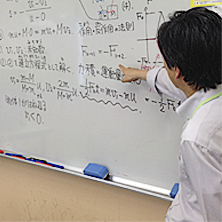
Foundation subject class (physics)
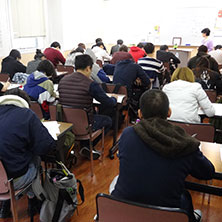
Mock exam for the EJU



Copyright© 2014 The Naganuma School.